
LaSalle Parish Criminal Case Files
A criminal court record is the case-level file kept once charges enter the court system. In LaSalle Parish, felony and district-level criminal matters route through the Twenty-Eighth Judicial District Court, with the Clerk of Court serving as the local court-record custodian. The file can include the charging document, minutes, arraignment record, plea, motions, bond orders, trial settings, verdict, disposition, sentence, probation order, and any expungement filing.
That court file should not be collapsed into an arrest page. A jail roster may show custody status and limited booking data, and a warrant contact may confirm an outstanding capias or bench warrant. The criminal court record shows what the court did with the case. For a closer look at the allegations filed after arrest, use the separate LaSalle Parish court charge records page; for all case types, use the broader court records page.
| Office or Court | Criminal Record Role |
|---|---|
| Twenty-Eighth Judicial District Court | Hears felony and district-level criminal matters for LaSalle Parish. |
| Clerk of Court | Maintains criminal case files, minutes, copy requests, and certified copies. |
| District Attorney | Files and prosecutes charges in District Court. |
| Sheriff | Maintains booking, bond, jail, warrant, and public-record contact channels. |
| Public Defender | Provides representation for eligible indigent defendants through District 28. |
Find LaSalle Parish Criminal Records
Official sources did not locate a free, broad LaSalle Parish criminal case search portal. The practical route starts with the Clerk of Court for the District Court file. A request should include the defendant's full name, case number if known, approximate filing or arrest date, charge or offense if known, and whether plain or certified copies are needed. The 28th JDC calendar can help with hearing awareness, but it is not the criminal case file.
For public criminal items outside the file, the Sheriff contact directory lists Records & Bonds and public-records request emails. For statewide criminal-history, expungement, or background-check processes, Louisiana State Police and BCII channels are separate from the parish court file. Each channel answers a different question, so the search path should be tied to the record needed.
- Start with the Clerk of Court when the goal is the District Court criminal case file or a certified copy.
- Use the 28th JDC calendar only to check schedule context and then confirm direct notice.
- Contact the Sheriff for jail, bond, booking, warrant, or public-record request questions.
- Use the District Attorney or court file to verify charges as filed, amended, refused, reduced, or dismissed.
- Use Louisiana State Police channels for statewide criminal-history or expungement process questions.
LaSalle Parish Criminal Case Flow
The case file grows as the matter moves through court. A charge may begin with arrest, citation, complaint, bill of information, or indictment, but the criminal court record focuses on the court's case activity. Minutes and docket entries can show when the defendant appeared, what plea was entered, what motions were filed, whether a trial was set, and how the case ended.
Case flow: Charges Filed › Arraignment › Pretrial and Motions › Plea or Trial › Disposition › Sentencing
| Stage | What Happens in the Record |
|---|---|
| Charges filed | The bill of information, indictment, or other charging document states the offense alleged in court. |
| Arraignment | The defendant is called to answer the charge and enter a plea such as guilty or not guilty. |
| Pretrial and motions | The file may show discovery motions, continuances, bond orders, suppression motions, or trial settings. |
| Plea or trial | The record shows whether the case ended by plea, bench trial, jury trial, acquittal, or dismissal. |
| Disposition and sentencing | The court records the outcome, sentence, probation, fines, costs, restitution, or other terms. |
LaSalle Parish Criminal Record Fields
LaSalle Parish research did not locate a public criminal case sample with all District Court fields visible online. The field inventory below uses the researched Louisiana court-file concepts and local 28th JDC docket context without claiming that each item is displayed in a free web portal. A certified or complete copy request should go to the Clerk when proof is needed.
| Field | What It Shows |
|---|---|
| Case number | The court's identifier for the criminal file, if known or located by search. |
| Defendant | The person accused in the court case, with identifying details as allowed in the file. |
| Charging document | Bill of information, indictment, complaint, or citation used to start the court charge. |
| Charges | The offenses alleged, including any amendments, reductions, dismissals, or nolle prosequi entries. |
| Arraignment and plea | Date of arraignment and plea entered, such as guilty, not guilty, or no contest where applicable. |
| Motions and hearings | Pretrial activity, continuances, suppression issues, trial settings, and court orders. |
| Disposition | The outcome for each charge, including dismissal, acquittal, guilty plea, verdict, or other resolution. |
| Sentence | Fine, court costs, jail or prison term, probation, restitution, or other court-ordered terms. |
| Restriction status | Sealing, expungement, juvenile confidentiality, or redaction limits. |
Louisiana law on criminal and investigative record access is shown in this official source image for La. R.S. 44:3.
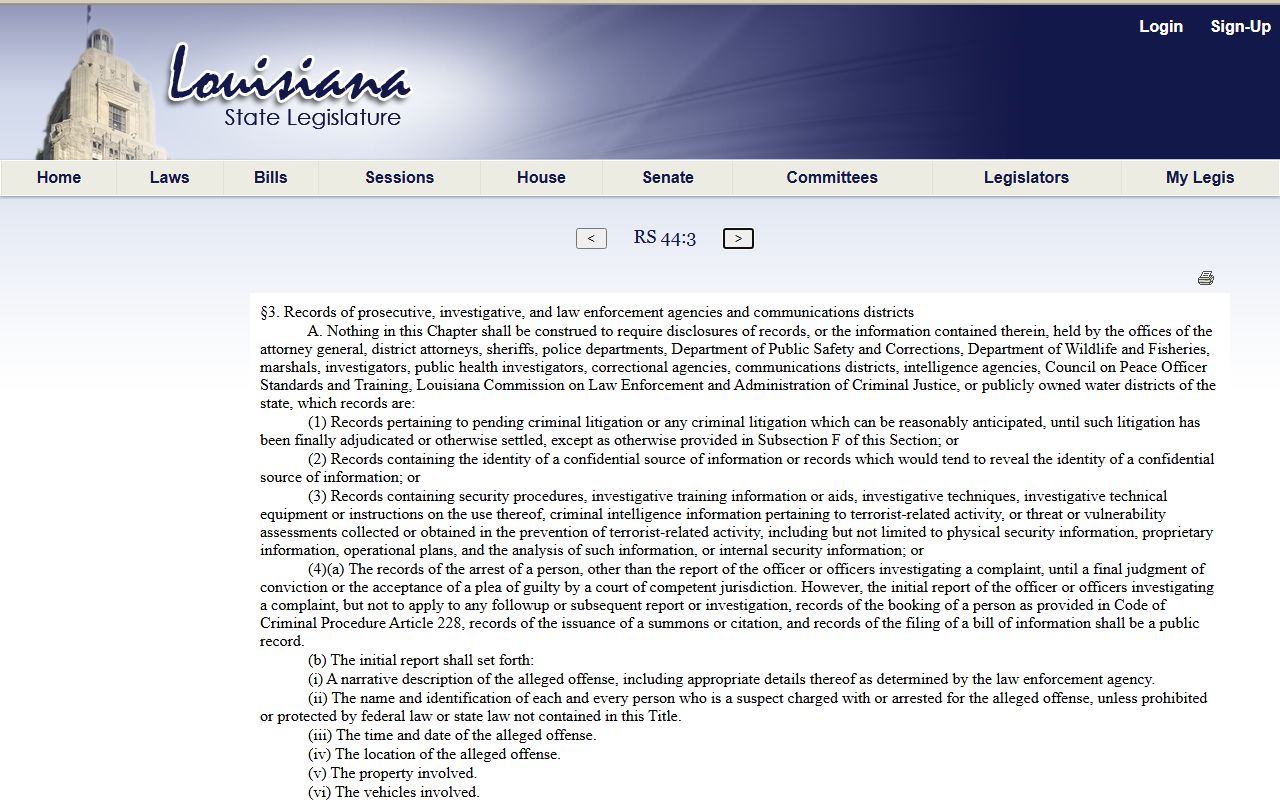
That statute is important because criminal case files, booking records, bills of information, and investigative materials do not all have the same public-access rule.
LaSalle Parish DA and Defense
The Louisiana District Attorneys Association roster lists J. Reed Walters for LaSalle Parish, with a Jena mailing address and office phone. The research file also notes a 2026 legislative resolution commending J. Reed Walters on retirement, while the LDAA roster still lists him. For that reason, published page content should say the roster lists him rather than speculate about successor timing.
The District Attorney's role connects arrest records to court charges. The prosecutor may accept, amend, refuse, dismiss, or reduce charges from the arrest stage, and the court file may show the formal bill of information or other charging document. Public defense is handled through Louisiana's District 28 public defender office. The District 28 OSPD page lists District Defender Derrick Carson, the Jena office, one court/division, and 405 individuals represented in CY 2025.
District Attorney, 28th Judicial District
J. Reed Walters listed by LDAA roster
PO Box 1940
Jena, LA 71342-1940
(318) 992-8282
District 28 Public Defender
District Defender Derrick Carson
3150 N. First Street
Jena, LA 71342
(318) 992-0881
Monday-Thursday, 8:00 a.m.-3:00 p.m.; Friday closed
The DA roster source is captured in the manifest image for LaSalle Parish criminal court records.
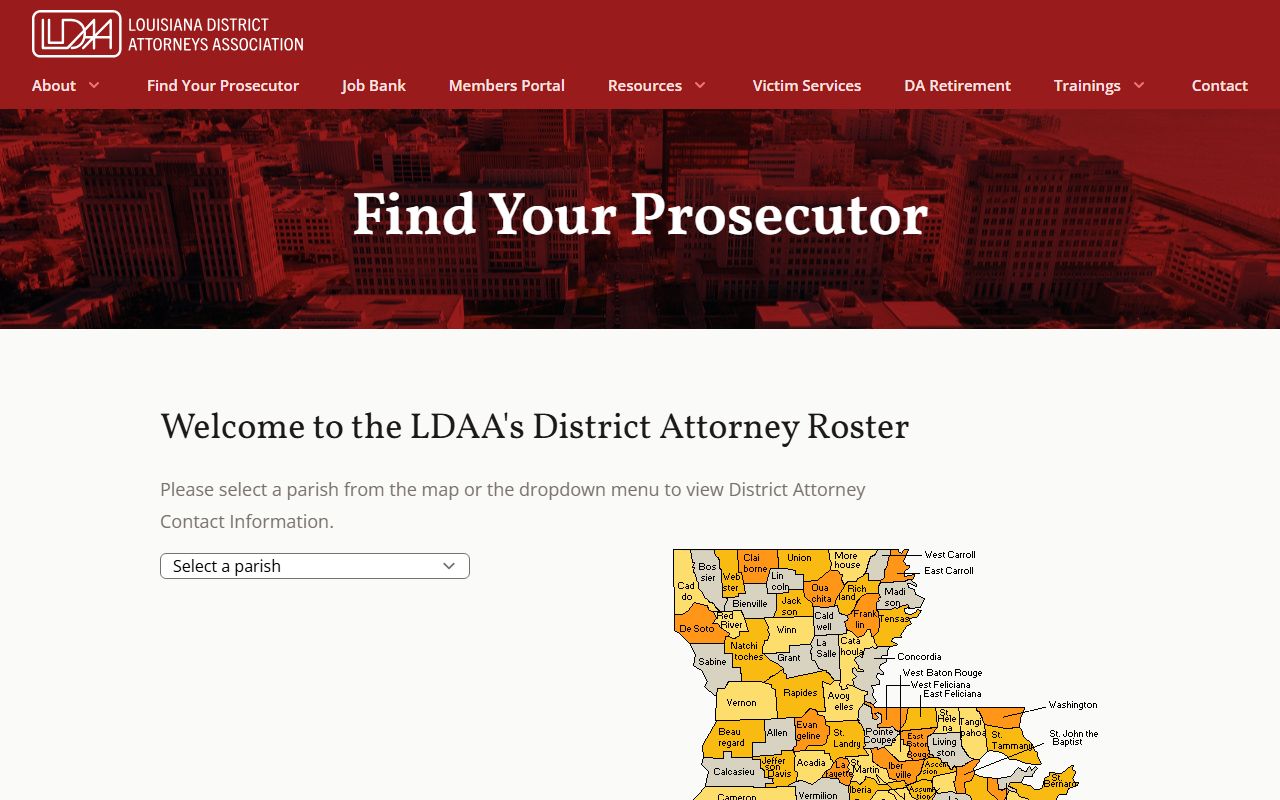
The source helps identify the prosecutor channel, while the Clerk's case file remains the place to verify court-file outcomes.
The District 28 public defender page is also included as a successful criminal-records image source.
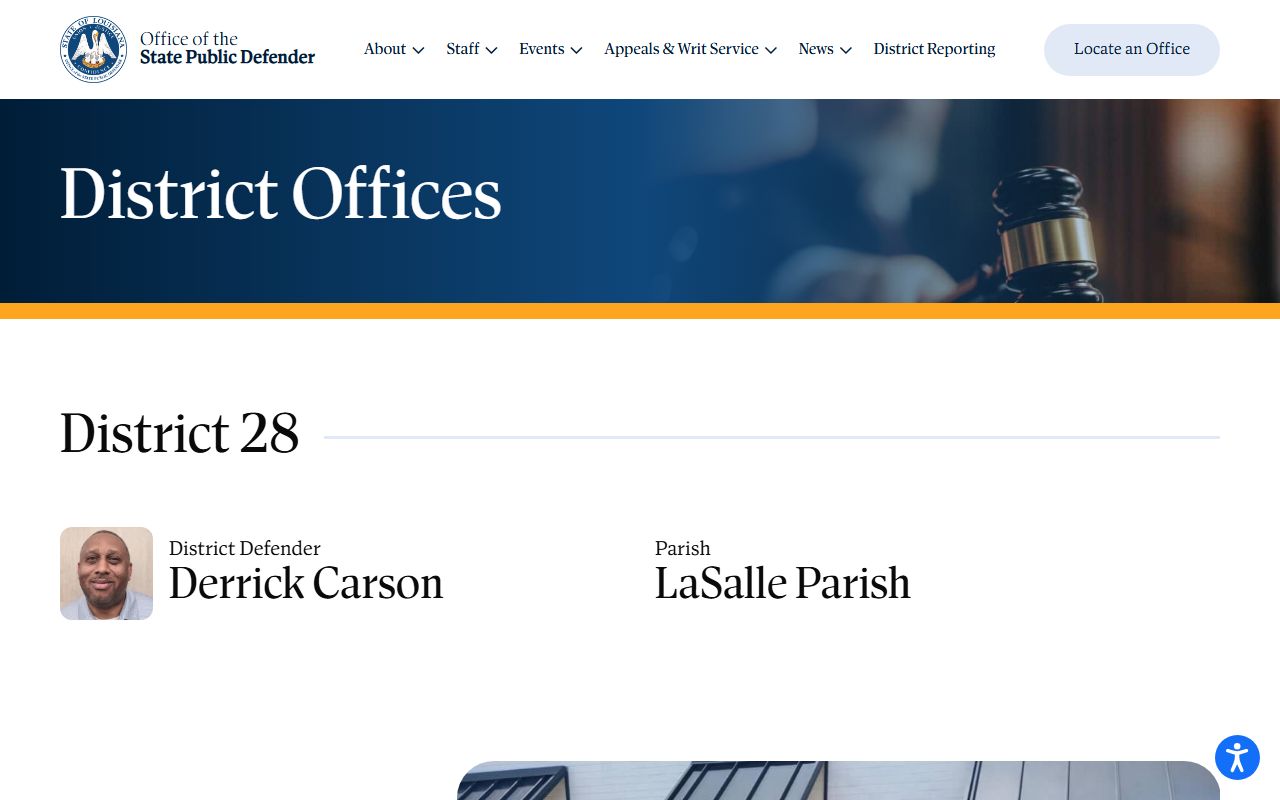
That image supports the defense-access section for eligible defendants in LaSalle Parish criminal cases.
LaSalle Parish Charges vs Convictions
A charge is an allegation. A conviction is an outcome after a guilty plea, verdict, or other qualifying court result. A LaSalle Parish criminal court record can show charges that were amended, reduced, refused, dismissed, or ended in acquittal. Reading only the first charge line can misstate the final case result.
| Charge | Conviction | |
|---|---|---|
| Meaning | Formal accusation filed or pursued in court. | Final finding or plea that supports judgment and sentence. |
| Where it appears | Charging document, minutes, bond papers, or docket entries. | Disposition, judgment, sentence, or minutes. |
| Can change | May be amended, reduced, dismissed, or refused. | May later be affected by appeal, post-conviction relief, or expungement limits. |
| How to verify | Check the filed charge and later docket activity. | Check the final disposition and sentence for each count. |
Public Access to Criminal Records
Louisiana public-records law gives broad access, but criminal court records have specific limits. Louisiana Constitution article XII, section 3 recognizes the right to examine public documents except as law provides. La. R.S. 44:31 gives adults inspection and copy rights unless another law applies. La. R.S. 44:3 restricts some criminal investigative records while identifying public items such as booking records and bills of information under listed exceptions.
For a LaSalle Parish criminal court record, the public-access question is not just whether Louisiana law favors access. It is also whether the requested item is a court filing, an investigative record, a juvenile record, an expunged item, a sealed file, or a record held by another agency. The Clerk, court, Sheriff, DA, and state police can each hold different criminal-process records.
Note: Criminal court records are case files; investigative records, jail entries, and statewide history reports follow separate access rules.
Sealed vs Expunged Criminal Records
Louisiana expungement does not mean destruction of the record. La. C.Cr.P. article 971 says expungement removes eligible records from public access, while agencies may retain and use expunged records as allowed by law. Sealed records are hidden from public view by statute or court order and usually require new authority or a court order to inspect.
| Sealed | Expunged | |
|---|---|---|
| Public visibility | Unavailable to the public by law or court order. | Removed from public access if the order applies. |
| Record status | The file still exists but is closed to normal public viewing. | The record is not destroyed under article 971. |
| Access after order | Usually requires legal authority or court order. | Criminal justice agencies may still access as allowed by law. |
| LaSalle filing path | Ask the Clerk or court about the sealed case. | LSP says forms and documentation are filed with the Clerk in the parish of arrest or conviction. |
The official Louisiana expungement article is one of the successful criminal-records image sources.
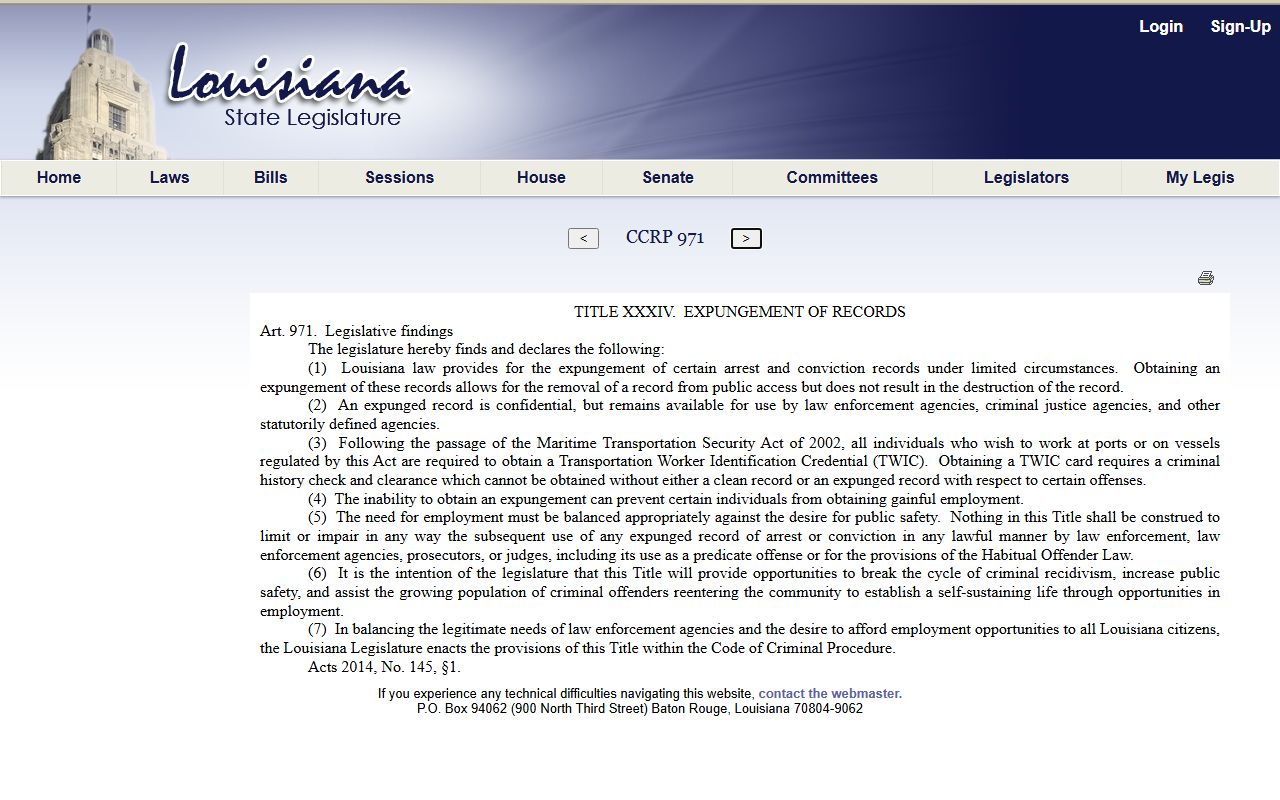
That source supports the distinction between public access removal and destruction of the underlying criminal record.
Louisiana State Police also publishes expungement process information for applicants.
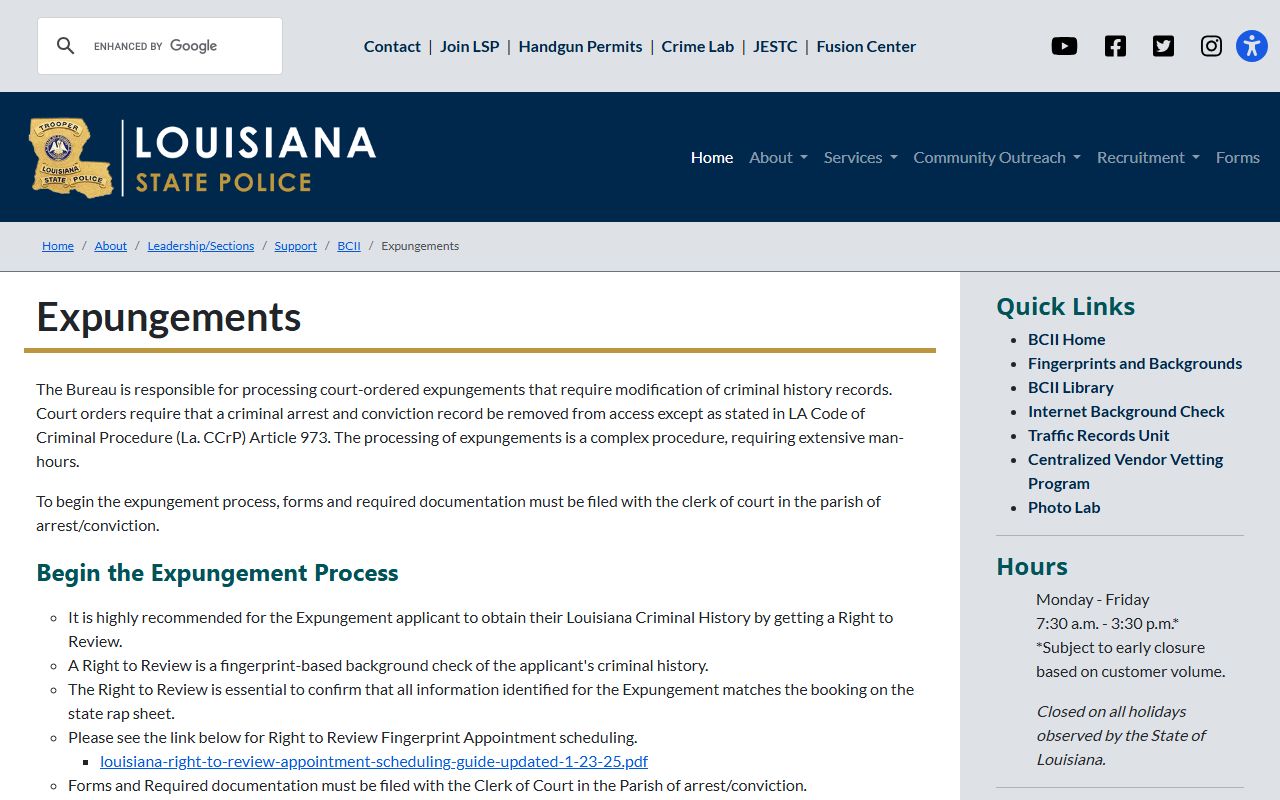
The State Police source points applicants back to filing forms and documentation with the Clerk in the parish of arrest or conviction.
Restricted LaSalle Parish Criminal Records
Restricted criminal records include juvenile matters, sealed files, expunged records, protected personal identifiers, victim information, confidential addresses, mental-health or medical material, and ongoing investigative records. Louisiana Children's Code article 412 makes juvenile court records and reports confidential except as authorized. That rule means juvenile delinquency information should not be treated as a public criminal court record search result.
Expungement requests in LaSalle Parish cases begin with the parish filing path described by Louisiana State Police: forms and required documentation are filed with the Clerk of Court in the parish of arrest or conviction. The applicant typically needs name, date of birth, arrest date, agency item number, arrest number or ATN, case number, charge, disposition, and proof of eligibility. The LaSalle Clerk price page did not publish a local expungement fee line, so the filing cost should be confirmed before submitting papers.